
-
 Continue reading →: Mastering Korean Indirect Speech: How to Report What Others Said
Hello, I’m Heeyoung! Welcome to Lal_la Korean. 🎶In Korean, when you want to deliver or report what someone else said, we use Indirect Speech (간접화법). Depending on whether the original sentence was a statement, a question, a command, or a suggestion, the ending changes. Let’s learn these patterns together so you can…
-
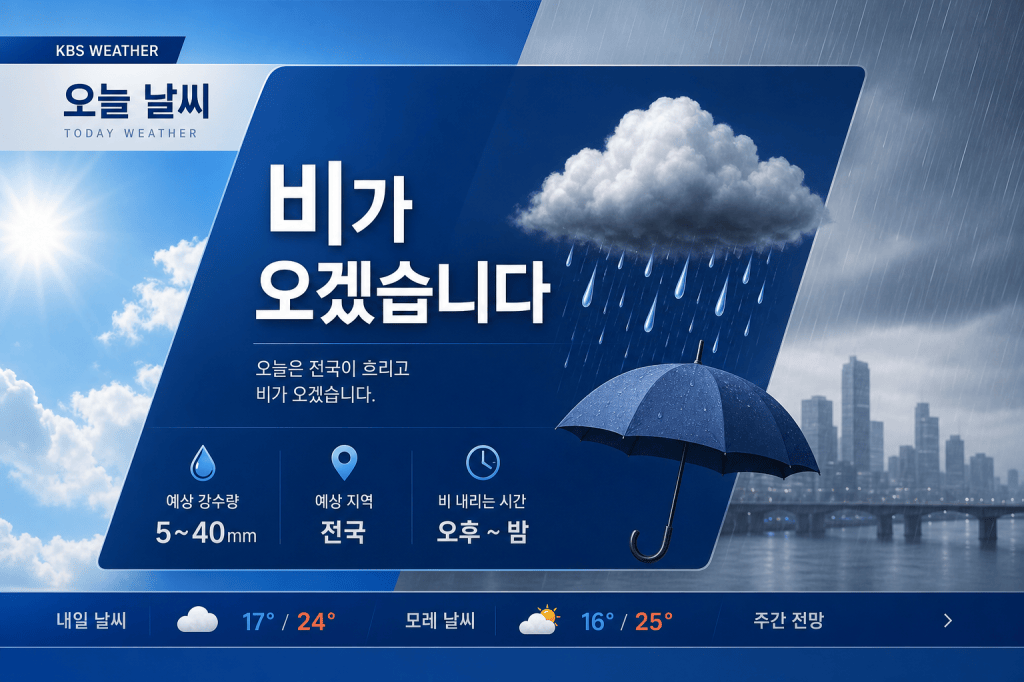 Continue reading →: Why do weathercasters say “-겠습니다”? (feat. 알겠습니다, 잘 먹겠습니다 🍽️)
You’re watching the Korean evening news, and the forecaster says:“내일은 비가 오겠습니다.” (It will rain tomorrow.) Wait — does that mean the weathercaster is promising to make it rain? 😄 Not quite! To understand why, we need to look at what -겠습니다 really means. 1. What does -겠습니다 usually mean? In English, it’s closest to “I…
-
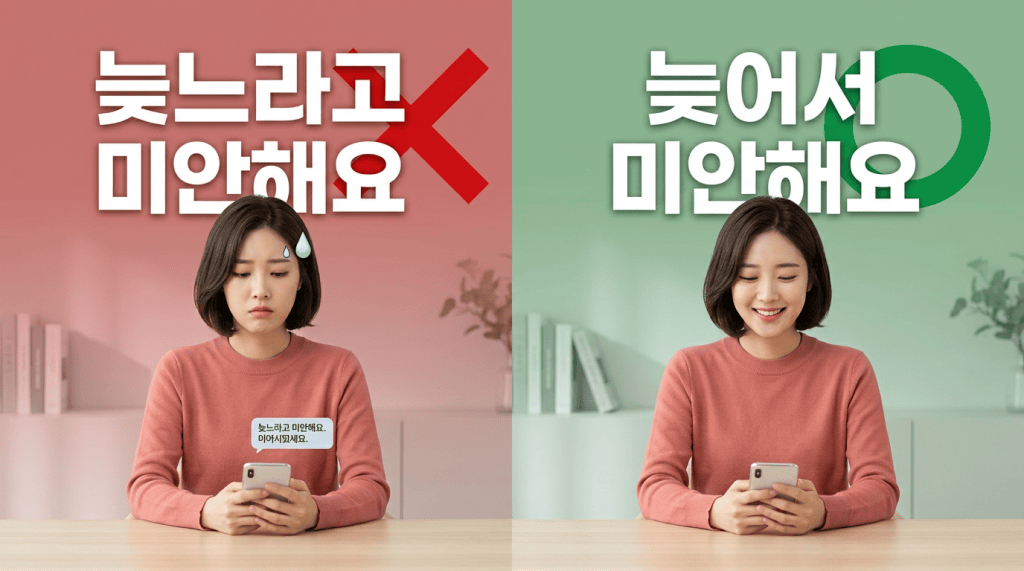 Continue reading →: “-느라고” vs. “-아서/어서”: Why Is “늦느라고” Wrong?
Have you ever wanted to say, “Sorry I’m late,” in Korean? You may know this sentence: 늦어서 미안해요.I’m sorry I’m late. But can you also say this? ❌ 늦느라고 미안해요. No—you cannot. 늦느라고 is not natural Korean. Both -아서/어서 and -느라고 can explain a reason, but they work in very different ways. Let’s learn when to…
-
 Continue reading →: Polite Request Endings -으세요 and -아/어/해 주세요: Nuances and Usages
How do you say “please open the window” in Korean? Is it “창문을 여세요” or “창문을 열어 주세요”? Are there any differences in nuance? The Korean verb endings “-으세요” and “-아/어/해 주세요” are both used to make polite requests, but they have distinct nuances and specific usages. Here is an…
-
 Continue reading →: Polite Requests: Mastering the Verb Ending ‘-아/어/해 주세요
In the drama “팬레터를 보내주세요 (Fan Letter, Please),” the expression “-어 주세요” is used to make a polite request or ask someone to do something. It’s a courteous way to ask someone to take specific action or fulfill a request respectfully. The title “팬레터를 보내 주세요 (Please send a fan…
-
Continue reading →: Overview of Korean Sentence Structure: Part 2 – Particles
Understanding the roles of predicates and particles in Korean sentences is essential for constructing and analyzing sentences effectively. These foundational concepts are the building blocks of Korean grammar, helping you navigate and master the language. In this part, we will discuss particles, which attach to nouns or pronouns to convey…
-
Continue reading →: Understanding the Differences Between “으니까” and “아서/어서/해서”
Why do we use different conjunctive endings in these sentences: 날씨가 추우니까 따뜻하게 입으세요. (The weather is cold, so dress warmly.) vs. 날씨가 추워서 두꺼운 옷을 입었어요. (The weather was cold, so I wore thick clothes.) The endings “으니까” and “아서/어서” both express reasons or causes, but they have distinct…
-
Continue reading →: Overview of Korean Sentence Structure: Part 1 – Predicates
Understanding the roles of predicates and particles in Korean sentences is essential for constructing and analyzing sentences effectively. In this part, I will discuss the foundational concept of the predicate in the Korean language.
-
 Continue reading →: How to Say “To Whom” and “From Whom” in Korean: Particles 에게, 한테, 께 vs. 에게서, 한테서, 께
In Korean, asking “To whom is she making a phone call?” or “From whom is she receiving the phone call?” involves specific particles attached to the noun. Here’s a detailed explanation:
-
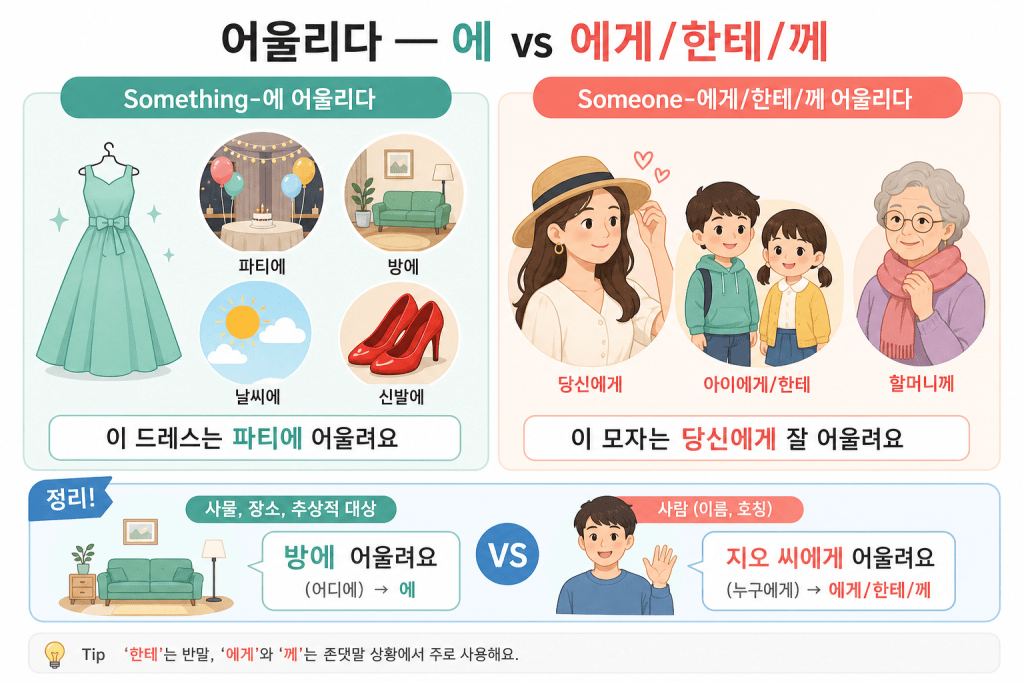 Continue reading →: ‘-에’ 어울리다 vs ‘-에게(한테, 께)’ 어울리다’
In Korean, the expressions ‘(Something)-에 어울리다’ and ‘(Someone)-에게(한테, 께) 어울리다’ are commonly used to describe how well something suits or matches a particular context, whether it be a thing, place, situation, or person. Understanding the proper use of these expressions can greatly enhance your ability to describe and communicate effectively…
Hello,
I’m Heeyoung.

Welcome to Lal_la Korean! As a certified language teacher, I invite you to join a joyful learning experience. The name “Lal-la” captures the joyful sound of singing in Korean. Let’s make your journey of learning Korean as enjoyable and fulfilling as singing “Lal-la.”
Let’s connect
Join the fun!
Stay updated with our latest articles and videos by joining our newsletter.
 Lal_la Korean